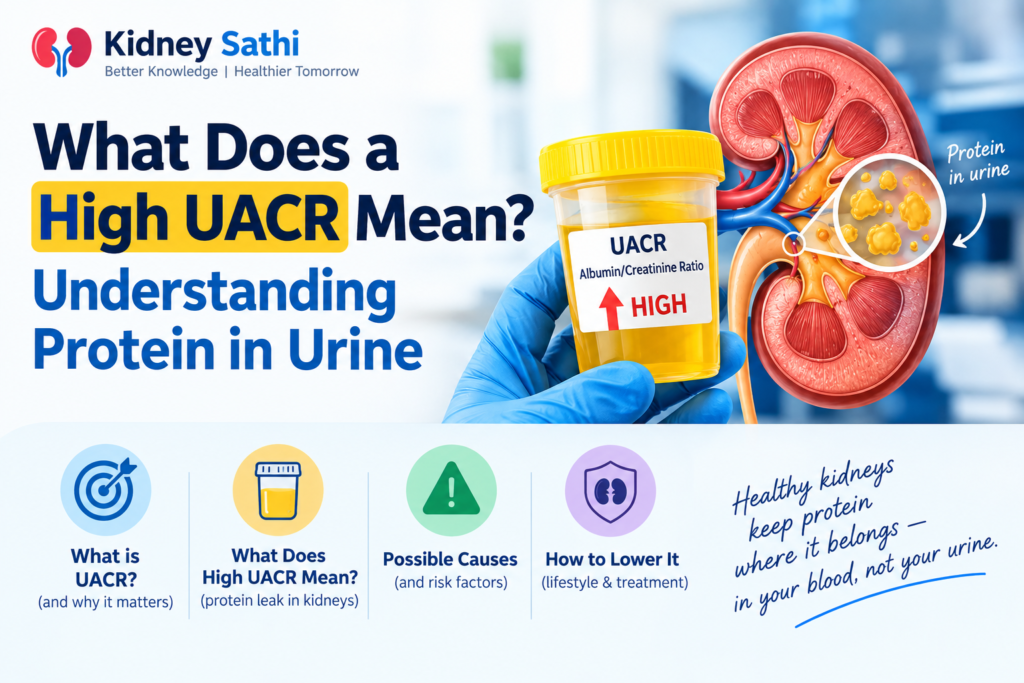
What Does a High UACR Mean?
If your doctor ordered a urine test and the result came back flagging a “high UACR,” you may have left that appointment with more questions than answers. Unlike more familiar tests like blood pressure or cholesterol, UACR isn’t something most people have heard of until a doctor brings it up — usually in the context of kidney health.
This guide explains exactly what UACR is, what a high result means, what typically causes it, and what steps make sense once you have this number in hand.
What Is UACR?
UACR stands for Urine Albumin-to-Creatinine Ratio. It’s a simple test that compares two things measured in a urine sample:
- Albumin — a protein normally found in the blood. Healthy kidneys filter blood carefully and keep albumin from leaking into urine in significant amounts.
- Creatinine — a waste product from normal muscle activity, released into urine at a fairly steady rate.
By comparing these two values as a ratio, doctors get a reliable snapshot of how much albumin is leaking into your urine, without needing a full 24-hour urine collection (which was the older, more cumbersome method).
The result is reported in milligrams of albumin per gram of creatinine (mg/g).
What Counts as a “High” UACR?
UACR results are generally grouped into three categories:
- Below 30 mg/g — Normal to mildly elevated
- 30–300 mg/g — Moderately increased (previously called “microalbuminuria”)
- Above 300 mg/g — Severely increased (previously called “macroalbuminuria”)
A “high” UACR typically refers to anything above 30 mg/g, with the severity increasing as the number climbs. It’s worth noting that even results in the 30–300 range — often dismissed as “just a little protein” — are clinically meaningful and worth monitoring, since this range often represents the earliest detectable stage of kidney damage, sometimes appearing before eGFR shows any change at all.
Why Does Protein in Urine Matter?
Healthy kidneys are selective filters. Their filtering units (glomeruli) are designed to keep larger molecules like albumin in the bloodstream, where they belong, while allowing smaller waste products to pass into urine for elimination.
When the glomeruli become damaged — whether from high blood pressure, high blood sugar, inflammation, or another cause — that selective filtering starts to break down, and albumin begins leaking through into the urine. This makes UACR one of the earliest and most sensitive indicators of kidney damage, often detecting changes well before eGFR drops or symptoms appear.
This is why doctors frequently order UACR alongside eGFR rather than relying on either test alone — together, they give a much fuller picture of kidney health than either number by itself.
Common Causes of a High UACR
A number of conditions and factors can lead to elevated albumin in the urine:
- Diabetes — consistently high blood sugar damages the small blood vessels in the kidneys’ filtering units, making this the leading cause of elevated UACR in the United States
- High blood pressure — sustained pressure damages glomeruli over time, allowing protein to leak through
- Chronic kidney disease — of any underlying cause, often shows up first as elevated UACR
- Urinary tract infections — can cause temporary protein elevation that resolves once the infection clears
- Recent intense exercise — can cause a short-term rise in urine albumin, unrelated to kidney damage
- Fever or acute illness — can temporarily elevate UACR
- Dehydration — can skew results, which is one reason doctors often ask for a repeat test
- Pregnancy-related conditions, such as preeclampsia
- Autoimmune or inflammatory kidney conditions, such as glomerulonephritis or lupus nephritis
- Heart failure, which can affect kidney blood flow and filtration
Because several of these causes are temporary or unrelated to chronic kidney disease, a single high UACR reading is not treated as a final diagnosis. Doctors typically want to see the result confirmed on a repeat test, usually collected first thing in the morning, before drawing firm conclusions.
Symptoms Associated With a High UACR
In earlier stages, elevated UACR usually causes no noticeable symptoms at all — which is exactly why it’s useful as a screening test rather than something people would otherwise catch on their own. As protein loss becomes more significant, some people may notice:
- Foamy or bubbly urine — often one of the first noticeable signs, caused by protein content changing urine’s surface tension
- Swelling in the legs, ankles, feet, or around the eyes (a sign of fluid retention as protein levels in the blood drop)
- Fatigue
- Loss of appetite
- Weight gain from fluid retention
If you’ve noticed persistently foamy urine, it’s worth mentioning to your doctor even if a UACR test hasn’t already been ordered.
What Happens After a High UACR Result?
If your UACR comes back elevated, here’s the typical path your doctor may follow:
- Repeat the test — usually with a first-morning urine sample, since results can be temporarily elevated by exercise, illness, dehydration, or even standing for long periods before the test.
- Check eGFR — to see whether kidney filtration capacity has also been affected, giving a fuller CKD staging picture.
- Review blood pressure and blood sugar control — since these are the two most common underlying drivers.
- Rule out a urinary tract infection, which can cause a temporary false-positive result.
- Consider additional testing — such as a kidney ultrasound or, in some cases, a kidney biopsy — if the cause isn’t clear from initial results.
- Referral to a nephrologist, particularly if UACR remains elevated across repeat tests, is above 300 mg/g, or occurs alongside reduced eGFR.
Managing a High UACR: What Helps
The encouraging news is that elevated UACR, especially when caught early, often responds well to targeted management:
1. ACE Inhibitors or ARBs
These blood pressure medications have a specific, well-documented benefit for people with elevated UACR: they reduce pressure within the kidney’s filtering units directly, which can meaningfully lower albumin leakage even in people whose blood pressure is already well controlled.
2. Blood Sugar Control
For those with diabetes, tighter blood sugar management — sometimes combined with newer medication classes that have kidney-protective effects — can significantly reduce UACR over time.
3. Sodium Reduction
Lowering sodium intake supports healthier blood pressure and may directly help reduce protein leakage in some people.
4. Weight Management
For those who are overweight, gradual weight loss has been shown to reduce UACR independent of blood pressure and blood sugar changes.
5. Avoiding NSAIDs
Regular use of NSAIDs like ibuprofen can worsen kidney filtration and protein leakage, particularly in people who already have elevated UACR.
6. Routine Monitoring
Repeat UACR testing — often every 3 to 6 months once an elevated result is confirmed — allows your care team to track whether interventions are working and catch further changes early.
UACR vs. eGFR: Why You Need Both
It’s a common misconception that eGFR alone tells the full kidney health story. In reality, UACR and eGFR measure different things:
- eGFR reflects how much blood your kidneys are filtering — essentially, filtration capacity.
- UACR reflects how well that filtering is being done — essentially, filtration quality.
It’s entirely possible to have a normal eGFR alongside an elevated UACR, and this combination is actually one of the earliest detectable signs of kidney disease — sometimes appearing years before eGFR shows any decline. This is why both tests are typically ordered together for anyone with diabetes, high blood pressure, or other kidney disease risk factors.
The Bottom Line
A high UACR means your kidneys are allowing more albumin to pass into your urine than they should — a sign that the kidneys’ filtering units may be under stress or damaged. It’s often one of the earliest detectable warning signs of kidney disease, frequently showing up before other markers like eGFR change.
A single elevated result isn’t a diagnosis on its own, but a confirmed high UACR is worth taking seriously — through blood pressure management, blood sugar control, medication choices, and regular monitoring. Caught early, elevated UACR is often manageable, and addressing it proactively can meaningfully protect long-term kidney health.
Frequently Asked Questions
What is a normal UACR range? Generally, below 30 mg/g is considered normal. Between 30–300 mg/g is moderately increased, and above 300 mg/g is considered severely increased.
Can a high UACR go back to normal? Yes, in some cases — particularly if the cause was temporary (like a urinary tract infection, dehydration, or recent intense exercise). When the cause is chronic, such as diabetes or high blood pressure, treatment can often lower UACR significantly, even if it doesn’t fully normalize.
Does a high UACR always mean kidney disease? Not always. Temporary factors can cause a one-time elevated reading. However, a UACR that remains elevated across repeat tests is a meaningful indicator of kidney stress or damage and warrants medical evaluation.
Is foamy urine always a sign of high UACR? Not necessarily — foamy urine can also result from urinating quickly or using certain toilet cleaners. However, persistently foamy urine, especially with other symptoms, is worth mentioning to your doctor.
Which is more important, UACR or eGFR? Neither is more important — they measure different aspects of kidney health and are most useful together. UACR often detects damage earlier, while eGFR reflects overall filtering capacity.
This article is for general educational purposes and is not a substitute for professional medical advice. Always consult your doctor or a nephrologist to interpret your own lab results.